Tag: Trailer

  • Heoric Doses of Reality

    Heoric Doses of Reality

        Integration
    Integration

    Peak existence is the new peak experience, says 5-MEO DMT expert Dr Malin Vedøy Uthaug

        By Trulee Hall from ‘Plays on Foreplays’, at      Rusha & Co, Los Angeles     , February 4 till March 11, 2023
    By Trulee Hall from ‘Plays on Foreplays’, at Rusha & Co, Los Angeles , February 4 till March 11, 2023

    The strictest lesson psychedelics taught me, is that they themselves are not important. It’s lived experience that is. 

    I don’t mean a Fabulous Furry Freak Brothers existence. (Although I am all for that too, especially as part of some ‘path of excess leading to the palace of wisdom’ thing). I mean stuff like Dr Malin Vedøy Uthaug does.

    The 5-MEO DMT research maven took up free diving while stuck in, y’know, Egypt during the COVID-19 pandemic.

    “I believe our society has emotional constipation. We need to get that shit out”

    This helped over come her fear of deep open water – ‘thalassophobia’ – and since she’s set two free diving records in her native Norway.

    “I believe our society has emotional constipation. We need to get that shit out,” says the firebrand, who’s swift to remind us that “different diets lead to a different psychedelic experience,” certainly according to plant medicine purists.

    This is felt on the material plane: “Putting the body back into the equation, is the way forward,” Dr Uthaug claims.

    This could mean bioenergetic therapy to encourage consciousness ‘integration’ on a physical level. Or… actually doing things as opposed to just talking about them

    “Changes need to be actively translated into your life,” says Dr Uthaug… which admittedly is likely to mean unexpected challenges, hard truths, and personal growth generally earned the hard way as per usual.

    “In the light of day, insights are about lifestyle”

    The trip is only part of the healing. You do the rest with the actions you undertake. That the mushroom or whatever told you to do.

    “A more holistic framework is what I’d love to see going forward, here in the space,” says Dr Uthaug, “Take an exaggerated example: when an addict take a psychedelic, they realise, oh, I shouldn’t be taking this substance anymore because it fucks me up, right? And so in the light of day, insights are about lifestyle.”

  • Kool-Aid Corner #18

    Kool-Aid Corner #18

    To finish: trippy clippings, merry pranks, and psychedelic student life

             Walter Van Beirendonck      autumn/winter 23/24 collection shown at Paris Men’s Fashion Week
    Walter Van Beirendonck autumn/winter 23/24 collection shown at Paris Men’s Fashion Week

    Graph of the Week

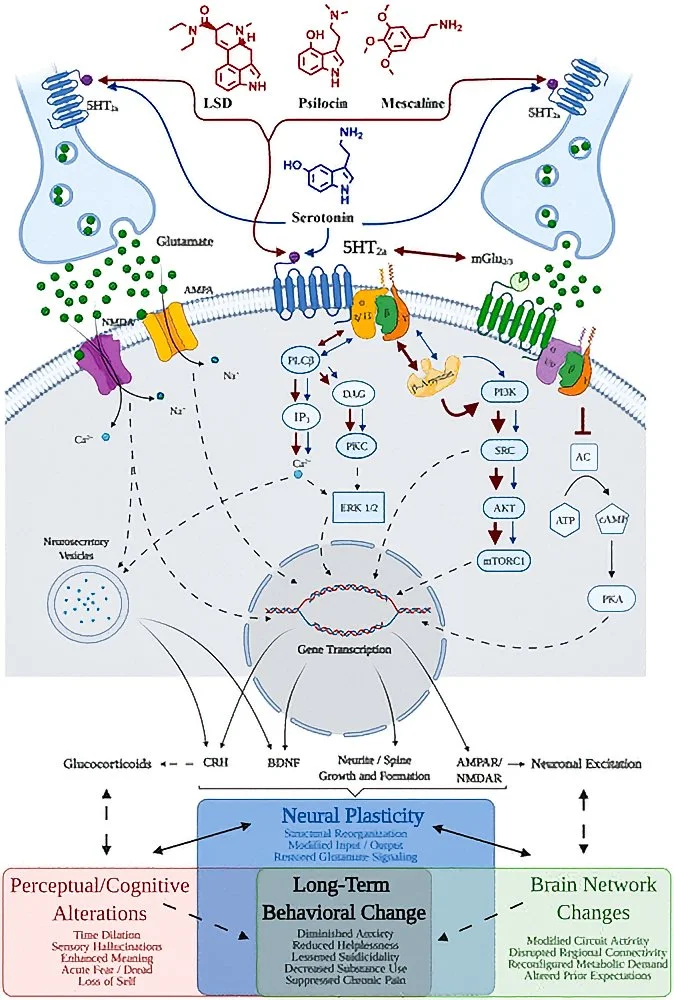
    This is how it works apparently:

        FIGURE 1: ‘Molecular, cellular, and systems support for psychedelic-induced long-term changes..’    From:    Catalysts for change: the cellular neurobiology of psychedelics    (Matthew I. Banks, Zarmeen Zahid, Nathan T. Jones, Ziyad W. Sultan, and Cody J. Wenthur, William Bement, Monitoring Editor) Molecular Biology of the Cell Vol. 32, No. 12
    FIGURE 1: ‘Molecular, cellular, and systems support for psychedelic-induced long-term changes..’ From: Catalysts for change: the cellular neurobiology of psychedelics (Matthew I. Banks, Zarmeen Zahid, Nathan T. Jones, Ziyad W. Sultan, and Cody J. Wenthur, William Bement, Monitoring Editor) Molecular Biology of the Cell Vol. 32, No. 12

    My bookshelf weighs a ton

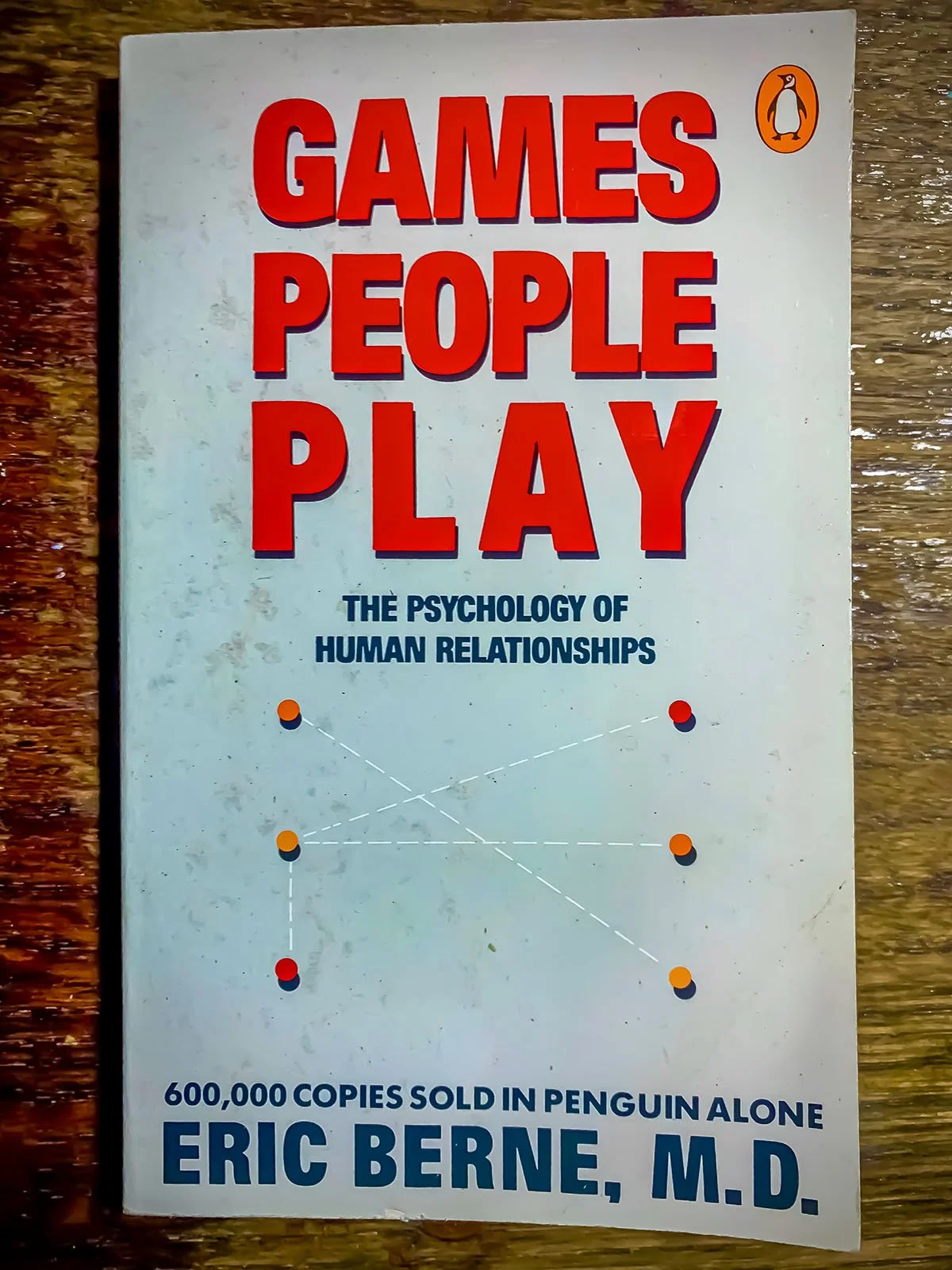
    Notable new purchases for the occult library. This week: Games People Play by Eric Berne 1968 Penguin edition!

         £3 from the second hand bookstore round the back of the sea front in historic Clevedon, North Somerset UK
    £3 from the second hand bookstore round the back of the sea front in historic Clevedon, North Somerset UK

    The first ever pop psychology book (although written for pros) debuted in 1964. In Berne’s ‘transactional analysis’ some human behaviours are learned strategies to elicit a response. (They’re mostly along the parent-child-adult drama triangle lines). Others find it exhausting, but the comfortable thing is to play along. ‘White moves first, and white usualy wins,’ writes Berne.

    Both the author, and our rational grown-up instincts, offer methods to dodge white’s curved balls. But he solemnly warns that all manner of pitfalls face those who refuse to play games. For example, white will not give up. They will simply find somebody else to play with.

  • The Feeling Theory

    The Feeling Theory

      Approach
    Approach

    Dr Lafrance mixes up emotion focussed therapy with a ‘theoretically informed’ treatment room style – that involves interacting with the patient

         By      Nokukhanya Langa      showing at Saatchi Yates gallery, London till November 22
    By Nokukhanya Langa showing at Saatchi Yates gallery, London till November 22

    “There’s been an evolution in psychedelic therapy, says Dr Lafrance, “I’m presenting all this next year, so you’re getting a sneak preview.” 

    Contemporary psychedelic medicine began with ‘experience’ sessions were ‘non-directed’, that is, given as little intervention as possible. (Psycholitic is the name given to experiences where talk therapy takes place). Soon they became ‘inner directed’ encouraging the voyager to get in touch with their ol’ inner healer.

    But now, “We’re moving towards a theoretically informed way of being in the treatment room,” Dr Lafrance reports, “especially when the inner healing intelligence is most active.”

    If like me you’re wondering what ‘theoretically informed’ means, well, from my Googling I figure it’s an academic term for ‘rooted in reality’ and usually involves some form of research and sense-checking from folks actually doing the thing in question.

    For instance: one paper I found, which researched ways to encourage intravenous drug users to be tested for hepatitis C, insisted it employed ‘evidence based and theoretically informed techniques’ gleaned from social workers.

    Dr Lafrance later describes herself as “a theory-based person” and I for one will happily accept her theories when it comes to ‘ways of being in the treatment room’, because she’s been a top-flight clinical psychologist for decades. 

    “They indulge in maladaptive coping behaviours and problematic relationships to cope… or risk more serious mind fractures” 

    The bubbly brainbox is also a renowned expert on Emotion Focussed Therapy (EFT); she’s the author of Emotion Focused Family Therapy: A Transdiagnostic Caregiver Focused Guide, published by the redoubtable American Psychological Association. 

    According to The International Centre for Excellence in Emotionally Focused Therapy (ICEEFT) website, EFT is closely related to John Bowlby’s Attachment Theory of Human Relationships. ‘Attachment views human beings as innately relational, social and wired for intimate bonding with others,’ it reads, ‘The EFT model prioritises emotion and emotional regulation as the key organising agents in individual experience and key relationship interactions.’

    Dr Lafrance says EFT focusses on emotion regulation and processing: “If they have low skills regulating emotions and stressors, and their resources are insufficient, they have to indulge in maladaptive coping behaviours and problematic relationships in order to cope – or they risk more serious mind fractures.” 

    In the EFT model, seemingly destructive patterns like addiction fend off worse outcomes like suicide.

    “You get this activated self rising like a phoenix. And it’s freaking awesome”

    Addicition’s an example of a coping mechanism that’s arisen to swamp the torturous emotional quagmire within.

    “Cross-diagnostically patients have problems with identifying and processing emotions,” says Dr Lafrance, “the symptoms are thought to be emotion regulation strategies. But if we can offer them support, including in strengthening their emotion regulation and processing skills, they receive co-regulation that in turn leads to self-regulation. Then they don’t need the coping patterns. It’s tackling the problem from the inside out.”

    “The key term,” says Dr Lafrance, “is self-efficacy,” meaning the power to deal with things yourself. “If you feel it with emotion processing,” she claims, “it’s incredible armour for the challenges of life: both the skills, and the support it provides.”

    Our emotional landscapes, though, can be foggy territory. Dr Lafrance has even felt the compulsion to hold free public workshops helping the great unwashed map out their own internal geography. Many of us are simply not literate enough to know that behind the emotion of ‘sadness’ there’s a need for ‘comfort’ from another – the common reaction is to withdraw for time alone instead. 

    “Which emotional states do they find most challenging to identify, label, meet and need?” advises Dr Lafrance, “Stick with the sense of helplessness and that turns into ‘it’s not fair!’ And then there’s a healthy rising up of assertiveness. Latch on to something, work with it in specifics ways that help it along, and you get this activated self rising like a phoenix. And it’s freaking awesome,” she says.

    As a people we’re so emotionally retarded that Dr Lafrance has found it’s sometimes best to simplify troubled emotions down into two categories.

    “In the past when I would’ve said ‘Feel into that space with me’ now I’d just say, let’s not go there if you’re not sure”

    ‘Anger, resentment and disappointment’ indicate a client who shies away from vulnerability. ‘Anxiety, sadness and despair’ point to low assertiveness.

    But “hate and resentment can feel like a comfy blankety” advises Dr Lafrance: “Some people subconsciously live their lives by the mantra ‘I’d rather die than feel’,” she says.

    This is where “accessing and understanding the genus of their difficulties” comes in. “One patient told me that their medicine sessions were the first time they’d sat in fear and sadness with memories they were trying to hide from,” she explains, adding that psychedelics can quieten a harsh inner critic that usually directs repressed feelings towards their holder, away from the recognition of painful events. 

    But, “EFT is less about the memories than it is about processing,” says Dr Lafrance, “they’re regulating, avoiding or suppressing affective material. Understanding the pattern can diffuse shame and assist in moving through the emotion.”

    To quote humanist psychologist Carl Rogers: ‘Once an experience is fully in awareness, fully accepted, then it can be coped with effectively, like any other clear reality.’

  • Four Times You Probably Should Intervene with the Voyager’s Experience

    Four Times You Probably Should Intervene with the Voyager’s Experience

      Therapy
    Therapy

    Frontline clinical psychologist answers the big question: when the patient’s tripping balls, when does the therapist definitely need to get involved?

         From      The Order of the Fool      Street Tarot exhibition in Manchester
    From The Order of the Fool Street Tarot exhibition in Manchester

    ‘This level of reality should be the new standard being applied to therapy in general’ says a Vital cohort colleague in praise of Dr Lafrance’s theoretically informed approach.

    “It’s different to how we were trained!” replied the respected frontline clinical psychologist. Like you can read about in the Approach section this issue, she combines emotion-focussed therapy with a ‘theoretically informed’ style taking cues from lived experiences received in the treatment rooms.

    This not only contrasts with bureaucratic doctrine, that favours centralised top-down wisdom… which can take decades to catch up with what’s happening on the ground.

    It’s also at odds the non-directive or ‘inner directed’ approach pioneered by Dr Stanislav Grof (for it is he) which insists on more delicate interaction with the therapist during the psychedelic experience itself, to encourage a more detailed internal dialogue. 

    “I do warn them in advance that they’ll be more aware than I am”

    That’s the the way psychedelic therapy is going though, Dr Lafrance claims.

    Those of us who were only just getting the hang of being non-directive may be left a-flutter by this sudden change in er, direction. So Dr Lafrance has kindly detailed the when’s and why’s of sticking your oar in during the voyager’s experience. 

    “We still intervene in a relational, emotion-focused, and inner-directed way,” she comments in her Vital lecture profiling the emotion-focused, theoretically informed style. 

    Dr Lafrance’s reasons for chipping in? Conflict with parts of the self. Maladaptive emotions like anxiety and self-criticism. Anticipated shame and regret, along the lines of ‘I can’t believe I told you that, it’s supposed to be a secret.’ And, reluctance. 

    Each must be handled gingerly, and always in the context of the medicine experience – hence ‘inner directed’ still, prompting the patient to look inside themselves, still.

    To confirm if your planned intervention is indeed worthwhile, confer with the handy acronym WAIT – ‘why am I talking?’

    “We make a deal in the container that I’m always fine”

    For instance: when confronted by the thought of a sober therapist and spangled patient, an old tripping pal of mine asked, “What happens when they realise they’re taking care of you?”

    He was offering up a psychedelic riddle-cum-truism. But it does happen according to Dr Lafrance albeit more prosaically. 

    “I do warn them in advance that they’ll be more aware than I am,” says Dr Lafrance, “We make a deal in the container [agreed-upon boundaries of behaviour while tripping] that I’m always fine.” Because when patients suddenly start insisting that you go outside for a smoke, grab a coffee, or take some time to yourself “it can be reassuring to just say that you are” says Dr Lafrance.

    “But it can be more rewarding to go into that place,” she advises, “is there a process of caretaking that needs looking into?’ Tell them that you’re always comfortable, they don’t need to worry if you’re hungry because it’s been four hours.”

    Otherwise, go get that brew now “Or it may feel like a violation.”

    Uncharacteristic behaviour can be examined by gently pointing out that “It’s so wonderful to get to know this part of you… feels like it’s a part that really need to show itself?”

    That attentive, experience-led vibe seems to be sweet spot of ‘theoretically-informed, inner-led, emotion-focussed therapy.’

  • Don’t Go There

    Don’t Go There

      Space
    Space

    Dr Lafrance doesn’t insist that patients ‘surrender to the medicine’ when they’re not up for a challenging experience

        By      Thomas Houseago      now showing with… Nick Cave and Brad Pitt at      Sarah Hilden Museum     , Tampere, Finland till 15 Jan 2023
    By Thomas Houseago now showing with… Nick Cave and Brad Pitt at Sarah Hilden Museum , Tampere, Finland till 15 Jan 2023

    In her preparatory sessions with clients, Dr Lafrance asks them what level of intensity they’re prepared to face.

    “What if a wariness of some feelings is an expression of the inner healer?” the storied clinical psychologist who “aims to be a steward of reality” asks Vital students, in her lecture on frontline applications of psychedelic therapy.

    And she doesn’t insist upon ‘surrender to the medicine.’

    “Any opportunity for pro-active shame work we will take,” she points out, “but if someone is expressing reluctance about pushing through, we’ll wait. This contrasts with prevailing psychedelic wisdom/gubbins, which practically demands patients stare directly into the eyes of any monsters: “In the past I would’ve said ‘feel into the space with me’ now I’d just say ‘No, let’s not go there if you’re not sure’,” Dr Lafrance reports.

    “What if a wariness of some feelings is an expression of the inner healer?”

    This ‘self interrupter’ part that forbids examination of traumatic feelings (especially when tripping balls) “was downloaded for a reason,” says Dr Lafrance, “Let’s respect it and go slow because that in itself can be powerful… by helping them be less afraid in the future.”

    So she’s fine with patients telling jokes, “which is awesome for people who have problems expressing joy and flexibility.”

    Dr Lafrance even gives a pass to ‘spiritual bypassing’ which as far as I can tell means ‘having any sort of trip that isn’t a clinical healing-type one’. 

    Those, as Vital students have been repeatedly told by big dogs like Dr Bill Richards, aren’t ever worth banking on anyway. 

    “Therapy comes more from process than outcome in the session”

    Indeed be wary of any dramatic, sudden, supposed healing advises Dr Lafrance.

    “If they realise they’ll feel bad tomorrow for acting out of the ordinary, that’s a sign it might be time to work with the shame. But if they’re throwing all their clothes off and shouting ‘I’m so sick of hating my body!’ it might be worth asking them what ‘Tomorrow You’ is going to think of all this. They realise you’re not trying to shame them. And they’re very grateful.”

    Dr Lafrance even assures patients not to feel they have to talk about things they really don’t want to. This is because “therapy comes more from process than outcome in the session,” she explains, “how did they engage with the parts of themselves and the therapist? That creates a different framework for engaging with the world.”

  • Anger is an NRG

    Anger is an NRG

      Medical
    Medical

    How to take a (small) step closer to the dark side for more assertiveness and self-compassion

        Adam Neate, ‘Retrato’ available from      Flurorescent Smogg
    Adam Neate, ‘Retrato’ available from Flurorescent Smogg

    The reconstructed self doesn’t take any crap.

    “Assertion is a common after-effect of medicine work,” says Dr Lafrance coyly, in her eye-opening lecture to Vital students on hw psychedelic therapy goes down in the real.

    Like the article says over in the Approach section of Zine #17 here, Dr Lafrance says therapists see two secondary emotions most commonly in the field.

    “Empowerment skills, when they’ve perhaps not been done before, are usually too mousey… or too much”

    Those two feelings she hears about the most are sadness, as one might expect from the depressed, and rage.

    “Anger is a challenge for many people,” says Dr Lafrance, “but not all anger is destructive. There is healthy anger.”

    This more righteous kind of fury can often be confused, shall we say, with assertiveness.

    “Culturally we really struggle,” comments Dr Lafrance, “I’ve been in therapy for 20 years working on my capacity for anger, standing up for myself, and asking what I need.”

    The rage-fuelled are shying away from vulnerability according to emotion focussed therapy, and it “shows up as these problematic reactions that fuel expression of symptoms,” says the clinical psychologist, somewhat eupehmistically.

    “Empowerment skills, when they’ve perhaps not been done before, are usually too ‘mousey’, or too much,” explains the blonde boffin, “plus the most predictable reaction to unexpected criticism is defensiveness.”

    Dr Lafrance provides scripted frameworks for the budding bearish buccaneer.

    “I always assume user error. You know, because it helps me to cultivate more sophisticated skill”

    She’s kind enough to share one with Vital students during the post-lecture Q&A, when I ask about help with my own fermenting… assertiveness.

    “I always assume user error. You know, because it helps me to cultivate more sophisticated skill,” she advises. 

    “If I’m expressing assertion, especially if it’s in a relationship where it’s kind of a novel experience, and it doesn’t go well… then I ask myself: ‘What am I doing or not doing to contribute to this problem?’” 

    That’s how she hit on the idea of detailled advice for pateints fumbling their way into self-confidence.

    “I was encouraging people to express assertion, and it’s not going well. So then I, as a therapist, asked myself ‘How did I contribute to that?’ Like, ‘Oh, shit, we didn’t warn them.’ So I wrote, I wrote the script now that I give to all the clients.”

    And it goes a little something like this:

    ‘I realised that I don’t always say or tell the truth about how I feel. Or about what I need. It’s hurting me.

    And I realise that makes it so that I’m not always honest in relationships. Because I’m scared that I’ll lose people important to me. Including you.

    “Not all anger is destructive. There is healthy anger”

    I really want to make a change in this way. I want to be more honest. And I want to have more faith.

    Faith that heart-centered motivation is there at the forefront. And faith that this relationship can sustain the changes that are required for it to evolve. 

    Would it be okay, if I started, in this relationship, being more honest about the things that hurt?

    Or the things that anger me? Knowing that it’s really because I want to find a new normal that will serve us both?’

    You might as well give it a go, you’ve tried evrything else. Could avoid an ‘Iatrogenic’ – therapist-induced – divorce.

  • Trip for me babe… trip for you?

    Trip for me babe… trip for you?

        Integration
    Integration

    After a fortnight in the jungle, your relationships might never be the same

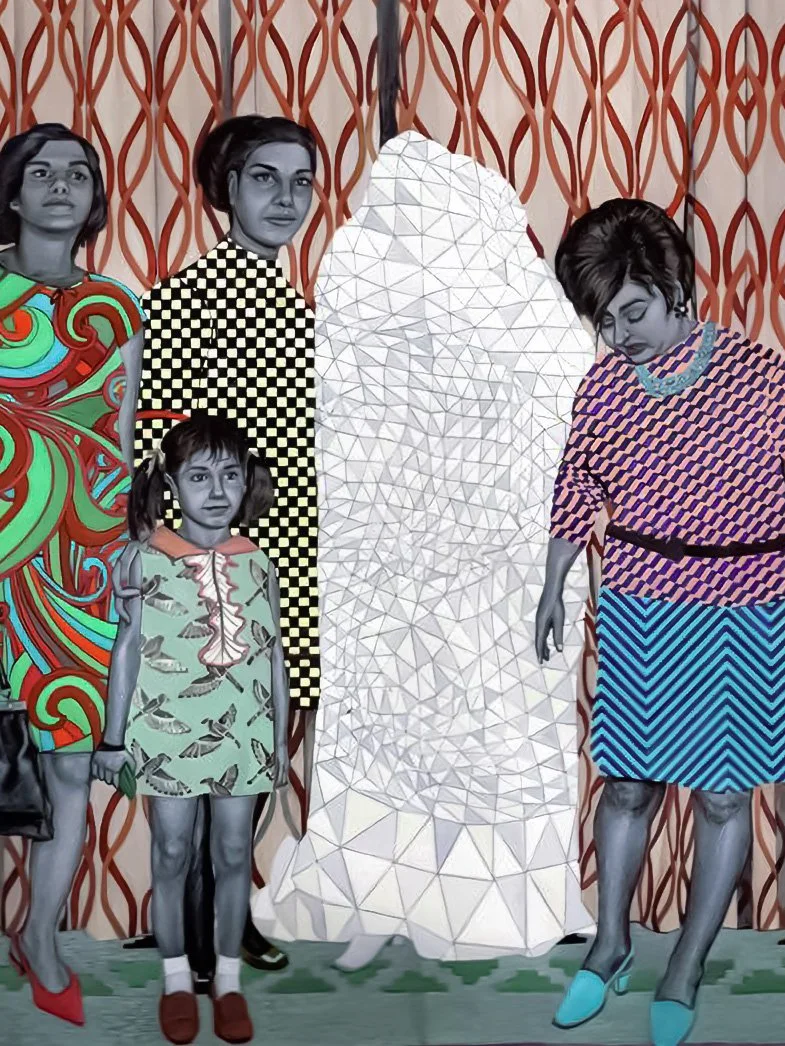
        Soheila Sokhanvari, The Gift, from the exhibition      Rebel Rebel at The Barbican     , London till 22 Feb 2023
    Soheila Sokhanvari, The Gift, from the exhibition Rebel Rebel at The Barbican , London till 22 Feb 2023

    “I’ve a feeling we’re inadvertently harming a lot of family members. If your partner goes for a two week ayahuasca retreat in the jungle, your life is going to change.”

    Thus warned Dr Adele Lafrance in her lecture to Vital students about how feedback from the frontlines is informing psychedelic therapy.

    And the emotion-focussed therapy expert told the Vital cohort that things can get even more cluster-fucked than that, once psychedelic rhetoric sets in. 

    “The concept of blame in psychedelic work is very delicate and potentially dangerous,” she says in her quietly subversive style, “there’s that fundamental belief that ‘we are all one’ and ‘inner conflict is related to outer conflict’.” 

    Transcendent resolutions usually only happen in retreat brochures. “Healing can be disruptive,” points out the self-declared ‘steward for reality’ – “We don’t want to throw anyone under the bus.”

    If handled correctly, “Holding the healing for the patient’s chosen, natural environment can encourage positive effects, lessen negatives, and evolve relationships,” says Dr Lafrance, improving key connections for the benefit of all concerned. 

    “Neuroscience supports the healing power of supportive caregiver-loved one reactions,” she continues, encouraging “Working at letting go of blame narratives and fantasy as a tool, in particular those involving our primary caregivers… as for some reason, at this stage of evolution, humans are strongly affected by the context of attachment relationships.”

    Psychedelic culture, its rhetoric at least, is infamous for butting up against reality: from free love to not doing any washing up in the hippy commune and the ‘all conflict is bad, mmm-kay?’ notion referred to by Dr Lafrance above.

    “It’s a skill to hold space for absent family members”

    And patient-voyagers often come crashing back down to Earth when they head back to the all-too-real environment of the office, family dinner table, or marriage bed.

    “As a field we need to think how we’re managing systemic stress,” says the working doctor, “If we foster asymmetry of growth by only treating one person, it can have worse outcomes for the client – breakdown of a marriage, for example. There is a high chance of getting divorced, when if we treated both the relationship could have thrived.”

    MDMA-assisted couples’ therapy is still a few years off. What can psychedelic therapists do to keep ‘systems’ like couples and families in union till then?

    “It’s a skill to hold space for absent family members. And it can be an especially complex skill to deeply validate the client’s experience while still honouring the family member,” advises Dr Lafrance.

    “We don’t want to throw anyone under the bus”

    She’s a specialist in Emotion Focussed Therapy (EFT) which has its own branch for next of kin, Emotion Focussed Family Therapy (EFFT).

    During Zoom lectures, “I normally have my hibiscus behind me,” says the congenial clinical psychologist, with no further explanation of her favourite flora’s current whereabouts, “I normally point at it while I say this; a client’s lineage makes up the whole plant. So, an example of what I might say [about their family] is, ‘Yes, they were not able – not didn’t care, or didn’t try. Let’s cultivate these experiences, so you can be the first flower in your family lineage to bloom.”

    Cod spirituality around ‘respecting the ancestors’ is best kept in mind, rather than hectored at the client. “We don’t have to tell the patient, but it’s important for us to remember the cultural, religious and social influences that changed the directory of their lives.”

    Here in the UK, family members have a legal right to a ‘needs assessment’ that can provide additional support, and a study on Multiple disassociation disorder (MDD) Dr Lafrance is consulting for here in Europe involves the family. “This could be a formal process during screening [in the USA] as things get legal, especially if they are under-resourced or unaware,” she says.

    Those of us who are wary of social services padding about our home, or feel their help may be superfluous, might also find ourselves cast in a role of responsibility, where certain emotions are unwelcome.

    And personally, I’ve seen more women presenting at services usually associated with men, like anger management (see the Kardashian sisters for a celeb example). It’s connected to a sense of overwhelment, usually from satisfying others’ needs before one’s own.

    “We don’t want people to taint our experience when it’s so fresh, raw and vulnerable. So we tell the family that they can’t expect to hear all about it”

    Says Dr Lafrance, “There are gender differences, unfortunately, that are still true you know, in terms of how we have been culturally conditioned to connect with emotions. Men still struggle more with sadness, fear and shame. Women, because of cultural conditioning, and socio-political movements meant to suppress female assertion, still struggle with healthy anger. So that’s why I use this dichotomy: ‘Which one is true for you?’ Because it’s not always gender specific, especially as we continue to evolve as a culture around questions related to gender roles.” 

    The respected clinical psychologist also recommends discretion around any potent visions and insights voyagers may’ve enjoyed. “At the end of the session we’ll ask the client what they feel comfortable sharing that doesn’t compromise them, their needs, or their integrity, but is still informed by what a couple might need. We don’t want other people to taint an experience when it’s so fresh, raw and vulnerable. So we tell the family that they can’t expect to hear all about it.” Bear in mind that sharing you spoke to an omnipotent mushroom counts for that.

    What if, like myself, you sometimes get carried away with the notion that everyone in your family would benefit from a little medicine work? 

    “When I was in the jungle what came up over and over again was – you have to be in touch with reality”

    In the post-lecture question and answer session, I asked Dr Lafrance how not to share too much with friends and family: “Yeah, in fact, that would be another point of direct intervention, actually. So thank you for bringing that up,” she replied, “If someone in the context of the ceremony, you know, or session says, like, ‘Oh my gosh, I wish my parents would do this, I wish my brother would do that, I wish my sister…’ then I will ask them to look more deeply into that.”

    Doing so might enable the patient to “Release themselves, and release that person from, you know, having to be at the same stage of healing,” says Dr Lafrance, “Release self first, release other second. And if that comes up in integration sessions, I would do it the same way – like, ‘Yeah, check in with the part of you that is longing for that. Let’s see what it needs. Let’s see what it says’.”

    Dr Lafrance can certainly tell you what the Grandmother Spirit had to say about her own familial ins-and-outs, during a lengthy ayauasca retreat.

    “When I was in the jungle, that was one of the things that came up over and over again – like, you have to be in touch with reality.” 

    Which is probably a better tip than ‘You must respect the ancestors.’ But like anything genuinely helpful, it’s not easy to take on board. 

    “They are limited in their capacities,” she explains, “And it’s not because they don’t love you. It’s not because they desperately want you to be different, that you’re not going to be able to get what you’re looking for. And so where else you’re gonna get it? Inside. And I cried many tears over that, you know, sprawled out on the earth outside of the maloca. Like, not wanting that to be true.”


  • Kool-Aid Corner #17

    Kool-Aid Corner #17

    To finish: trippy clippings, merry pranks, and psychedelic student life

    Graph of the Week

    A model of ‘psychedelic instrumentalisation’ by early humans, and of the evolutionary consequences of its intergenerational recurrence…

      Figure 1: ’A model of psychedelics instrumentalisation by early humans, and of the evolutionary consequences of its intergenerational recurrence. The left side represents the process of instrumentalisation, which can occur repeatedly across the life-span of a generation of hominins. The right side represents the process of niche-construction supporting gene-culture coevolution across generations as populations construct and bequeath transformed ecological and social environments that exercise selective influences on following generations (Odling-Smee et al., 2003). The left side of the diagram portrays potential selective advantages conferred by psychedelic use under the socio-ecological conditions in which our ancestors evolved. The right side illustrates the process of selective feedback through which psychedelic instrumentalisation could have enhanced the creation and evolution of the human socio-cognitive niche. The four coloured boxes on the left represent the major aspects of the emerging human adaptive complex that created the socio-cognitive niche; these involve skills and processes potentially amplified by psychedelic instrumentalisation, with the two-directional arrows between the boxes representing the interconnectedness of these competence realms that coevolved in creating our unique adaptation mode. The emergence and persistence of this adaptive complex across human evolution permitted the progressive construction of socially modified environments (represented by the green box at the right side of the diagram) that in turn selected for enhancements in the same underlying human propensities and capabilities (represented by arrows with a plus [+] sign) that sustained the socio-cognitive niche.’  From:  Psychedelics, Sociality, and Human Evolution  by José Manuel Rodríguez Arce and Michael James Winkelman, published in Frontiers of Psychology, September 2021.
    Figure 1: ’A model of psychedelics instrumentalisation by early humans, and of the evolutionary consequences of its intergenerational recurrence. The left side represents the process of instrumentalisation, which can occur repeatedly across the life-span of a generation of hominins. The right side represents the process of niche-construction supporting gene-culture coevolution across generations as populations construct and bequeath transformed ecological and social environments that exercise selective influences on following generations (Odling-Smee et al., 2003). The left side of the diagram portrays potential selective advantages conferred by psychedelic use under the socio-ecological conditions in which our ancestors evolved. The right side illustrates the process of selective feedback through which psychedelic instrumentalisation could have enhanced the creation and evolution of the human socio-cognitive niche. The four coloured boxes on the left represent the major aspects of the emerging human adaptive complex that created the socio-cognitive niche; these involve skills and processes potentially amplified by psychedelic instrumentalisation, with the two-directional arrows between the boxes representing the interconnectedness of these competence realms that coevolved in creating our unique adaptation mode. The emergence and persistence of this adaptive complex across human evolution permitted the progressive construction of socially modified environments (represented by the green box at the right side of the diagram) that in turn selected for enhancements in the same underlying human propensities and capabilities (represented by arrows with a plus [+] sign) that sustained the socio-cognitive niche.’ From: Psychedelics, Sociality, and Human Evolution by José Manuel Rodríguez Arce and Michael James Winkelman, published in Frontiers of Psychology, September 2021.

    My bookshelf weighs a ton

    Notable new purchases for the occult library. It’s supposed to be strictly second hand snap-ups only. But I’m flagging on that to be honest. It’s now more in the spirit of a second hand bookstore. This week: The Entropy of Bones by Ayize Jama-Everett

         You’ll probably have to get it from/in America or off of Amazon
    You’ll probably have to get it from/in America or off of Amazon

    Ayize Jama-Everett handled the psychedelic racial awareness training on Vital. There’s a bit of a syncronicity here because I came across his name before in relation to my martial arts side hustle Battles of London (‘The brand making fight clothing cool’ says Men’s Health). I was going to hassle him for a short story for our print mag. But, y’know, lockdown.

    Reading the signs, I bought this one because it had a snake on it.

    The cover’s actually by John Jennings, a top-flight comic artist (and more) who Jama-Everett’s created a graphic novel with. Actually, one of the things I admire about The Entropy of Bones is that Jama-Everett must get told all the time ‘Why isn’t it a graphic novel?’ and that he’s nonethless written two others in the same vein (series, in fact).

    Anyway, what’s really good about The Entropy of Bones is it’s about getting into your body. Which is admittedly also in danger of bnecoming psycedelic rhetoric, one of the unofficial themes of this Unofficial Vital Student Zine.

    Plus there’s lots of other five star biz too, like: super-powered martial arts, smokeable psychedelic fungi, international-level decadence, weed farming and jungle drum ‘n’ bass.

  • Appliance of Science

    Appliance of Science

      Approach
    Approach

    Purists sneer at scientific tinkering. But lab studies showed Dr Nichols how psychedelics heal the body. Could he uncover the secret of profundity too?

         By      Ryoichi Kurokawa
    By Ryoichi Kurokawa

    Neuroscience is different to other aspects of psychedelic study, ‘since it is so spectacularly and usefully right over so many things.’

    Raymond Tallis wrote those semi-satirical words in Aping Mankind: Neuromania, Darwinitis and the Misrepresentation of Humanity. Neuroscience ‘is often given authority where it has none’ warns Tallis.

    Grudgingly I admit all those long words and graphs might come across well in a formal context. During a presentation to drug legislators, for example. Certainly compared to showing a clip of Tales from the Trip on the the meeting room’s wall-mounted LCD screen. 

    So it’s sweetly satisfying for heads to beat bureaucrats at their own game with the slew of pro-psychedelic neuroscience stats flooding out of respected institutions.

    Granted, the arcane apparatus of the psychedelic experience itself remains beyond even the grasp of they who have mastered the most multisyllabic words from this incomprehensible, in-style, inculcation. 

    “That’s still a wide open mystery,” confesses Dr Charles Nichols, eminent psychedelic pharmacologist and Vital neuroscience lecturer.

    “Specific pathways may be involved in the psychedelic process”

    Charles is the son of Dr David Nichols, chemist to the stars. David made the DMT for Rick Strassman, MDMA for MAPS and psilocybin for Johns Hopkins.

    “Back in the 2000s my father’s lab looked at the cross talk downstream from when G-alpha-i protein interacts with a specific beta and gamma that activates a hormone called Src, which then activates a series of enzymes. That’s the very top effector.”

    Right. No wonder nobody’s got to the bottom of it as yet. 

    “Specific pathways may be involved,” Charles whispers conspiratorially to the cheap seats.

    No talk of neuroscience in these pages is complete without a mention of Greatest Living Englishman Dr Robin Carhart-Harris.

    Dr Carhart-Harris’ sympathetic yet rigorous research at scientific bastion Imperial College London brought the psychedelic experience its medical legitimacy. His REBUS, ‘relaxed beliefs under psychedelics’ model is widely considered the neatest summation of psychedelic neuroscience. (without wishing to damn it with faint praise). 

    “My lab studies what psychedelics do that serotonin doesn’t”

    For anyone too embarrassed to ask the scientific way to say ‘tripping’ is ‘Relax the precision of high-level priors or beliefs, thereby liberating bottom-up information flow, particularly via intrinsic sources such as the limbic system.’ Obviously.

    Dr Charles Nichols is a pharmacologist developing new drugs. Unlike his celebrated psychedelic chemist dad Dr David, Charles has the benefit of Carhart-Harris’ research, or its slipstream at least.

    Charles uses his prodigious skill with the pestle, mortar and petri dish to identify, isolate and augment certain properties within his arsenal of exotic designer psychedelics.

    Specifically, “The study is my lab now is around what psychedelics do that serotonin itself doesn’t,” says Charles. 

    Which is a lot.

    He’s already found that mescaline-derived DOI has a tremendously positive effect on inflammatory conditions including asthma. And, he’s worked out that it’s not even one of the bits that makes you trip. Which has implications aplenty for widespread use. And the sensitive conversation around non-psychedelic psychedelics.

    (Ethnobotanist Richard Evans Schultes wrote in 1938, “Some of the ills listed as responding to peyote were tuberculosis, pneumonia, scarlet fever, intestinal ills, diabetes, rheumatic pains, colds, grippe, fevers and venereal diseases.” Cheers Mark Gunther of Lucid News).

    Psychedelics possess less ‘inhibitory’ effects on brain receptors that might suppress ‘excitatory’ ones, compared to serotonin. They hit the accelerator while cutting the brakes: boosting neurotransmission while hindering the body’s autonomous attempts to bring body chemistry back to ‘normal’.

    “The profound and mystical effect itself is still a mystery”

    This initiates a ‘synaptic cascade’ of excitatory messages. Once that gets to the Raphe nuclei in the brain stem connected to the whole brain, it’s blast off.

    The resulting “downstream cross talk” takes an unusual route through the nervous system. Precisely what is a little vague. Zen meditation buff Dr Bryan Roth is on it with a system he calls ‘TRUPATH, an open-source biosensor platform for interrogating the GPCR transducerome’. He’s also the guy making the non-psychedelic psychedelics for DARPA.

    “All psychedelics have a surprisingly different set of reactions with the 5-hydroxytryptamine receptors associated with serotonin,” says Charles, “but they all work on 5-hydroxytryptamine receptor 2a.” 

    Neuroscientists gave it with the catchy nickname ‘5-HT2a’. Relax, they’ve got loads more.

    Mescaline for example only activates two other receptors besides 5-HT2a. LSD’s “complex pharmacology” on the other hand means it interacts with 17 different receptors in total.

    ‘The phrase 5-HT2a agonist has supplanted psychedelic, which still carries faint whiffs of hippie-era hedonism,’ tech bible Wired tipped us off in its recent feature The High-Stakes Race to Engineer New Psychedelic Drugs.

  • Neuroplastic Smiles

    Neuroplastic Smiles

      Therapy
    Therapy

    “Biology drives the effects of psychedelics but therapy shapes them,” says the latest scion in the Nichols psycho-pharmacological dynasty

         Ron English,      ‘Rabbit Grin’
    Ron English, ‘Rabbit Grin’

    The freshly ‘neuroplastic’ brain and new grey matter created during ‘neurogenesis’ both require careful curation from therapy afterwards, declares Dr Charles Nichols.

    It’s notable that a hardcore neuroscientist stresses the importance of combining his drugs with talk therapy.

    “If you don’t have therapy in the weeks after you may go back to that baseline state,” says the star chemist, “the process strengthens newly made connections and dampens old ones.”

    It’s a clear decision he’s come to after a career formally studying the effects of mind-altering chemicals, under exhaustive laboratory conditions. And taking fatherly advice from dad David, the most prolific psychedelic chemist of his generation. 

    ‘Neuroplastic’ effects last for many days after the psychedelic experience itself. Little spiky nodules sticking out from the surface of brain cells called ‘dendrites’ grow in cells all over the brain. This provides fertile ground for fresher, healthier thinking patterns to germinate and grow. 

    ‘Neurogenesis’ is different. It’s the generation of new brain cells. Those ones your school nurse said you’d never get back. Admittedly establishment science is yet to entirely admit she was be wrong. Humans are only capable of neurogenesis in the hippocampus, boffins reckon. We get it from aerobic exercise, sex, worthwhile achievement and all the other good stuff.

    No prizes whatsoever for guessing what else is said to cause neurogenesis. 

    Say neurogenesis is real and not some figment of the ever-lively psychedelic imagination. Given it definitely happens in chimps and rats it probably is. These new brain cells require injecting with healthy thought patterns by integration tactics and therapy too.

    What’s more, Dr Charles Nichols, born of David, categorically states that psilocybin is a more effective anti-depressant treatment than ketamine.

    “If you don’t have therapy in the weeks after you may go back to that baseline state”

    Although ketamine boasts impressive effects including its distinct ‘glutamate surge’ and anti-microbial properties, Charles’ rats felt psilocybin’s anti-depressant powers for much longer.

    Real psychedelics use their own neuropathic pathway to create neuroplasticity, believes Charles, not the MTOR pathway usually associated with glutamate-derived GABA and any ketamine-led ‘surge’ thereof. 

    Charles’ lab rats are still above their baseline satisfaction scores three months into the official testing period and counting. On ketamine they were back to baseline after one week. “Both will snap back but the difference is significant,” comments Charles.