Category: Approach

  • New Aion

    New Aion

      Approach
    Approach

    Carl Jung applied scientific rigour to mystic wisdom. His alternative psychology provides a framework for psychedelic integration. Only now are its most profound messages coming to light

          Evan Roth   , ‘Landscapes’ at Wavelength: A Momentary Spring, Beijing Times Art Museum till 1 July
    Evan Roth , ‘Landscapes’ at Wavelength: A Momentary Spring, Beijing Times Art Museum till 1 July

    ‘The years when I pursued my inner images were the most important time of my life. Everything else is derived from this,’ opens Jung’s masterwork The Red Book.

    Leading psychedelic voices say Jung’s established, if exotic, psychology provides an explanatory framework that complements and legitimises the visionary psychedelic experience. Yes, your trippy bullshit is of significance after all.

    ‘Godfather of Psychedelic Therapy’ Dr Stanislav Grof writes in his definitive work LSD Therapy ‘The only psychiatrist who systematically explored and described many of the transpersonal phenomena we see is Carl Gustav Jung.’

    But, “It seems unlikely Jung took psychedelics” writes my Vital tutor Johanna Saponnen in Philosophy of Psychedelics (out now in paperback). Her extensive mapping of Jung’s work comes to mixed conclusions. The acclaimed early 20th century psychologist cautioned fellow intellectuals against the mescaline trend in his correspondence. But his interest seemed piqued by LSD just before his death in 1965 aged 85.

    Jung believed delving into our imaginations, instincts and personal mythologies – using techniques he bastardised from alchemy and mysticism – was fraught in itself. Which is possibly fair enough.

    “It seems unlikely Jung took psychedelics”

    Whether Jung had his wings or not he certainly seemed to know his way around the astral plane, and beyond. Interpreting plus integrating dreams and visions, primeval male and female forces, kabbalistic mental alchemy, re-enchantment, re-storyfication, ‘ancestor work’ the importance of a spiritual practice and – yes – ‘the shadow’ were Jungian tropes. 

    He said nature could ‘make us unconscious’ and warned of its potency. Jung was even into embodiment, stressing the importance of a daily yoga practice. He essentially converted to mysticism (despite doggedly maintaining an empirical attitude) after a premonition of the First World War. A spiritual crisis provoked by conflict between his scientific and spiritual sides drove him into isolation. 

    “The only psychiatrist who explored transpersonal phenomena is Carl Gustav Jung”

    Therein he painted and drew, as opposed to wrote, The Red Book an illuminated train of thought manuscript exploring his most conceptual hypotheses. Jung was so conscious of its obscurity that he only showed it to a handful of confidants. This definitive work of human endeavour was finally published in… 2020. 

    It’s not your average mash-up era comeback. And before you conclude the bookish-seeming Jung mustn’t have done his own shadow work, turns out he was a shall-we-say ‘photo polyamourist’ and college jock who swerved penury by marrying an heiress to the IWC Swiss watch dynasty.

  • Into the Unknown?

    Into the Unknown?

      Approach
    Approach

    Virgin voyagers come to psychedelic specialists for advice on what to expect. Break them in gently with a mock psychedelic ceremony

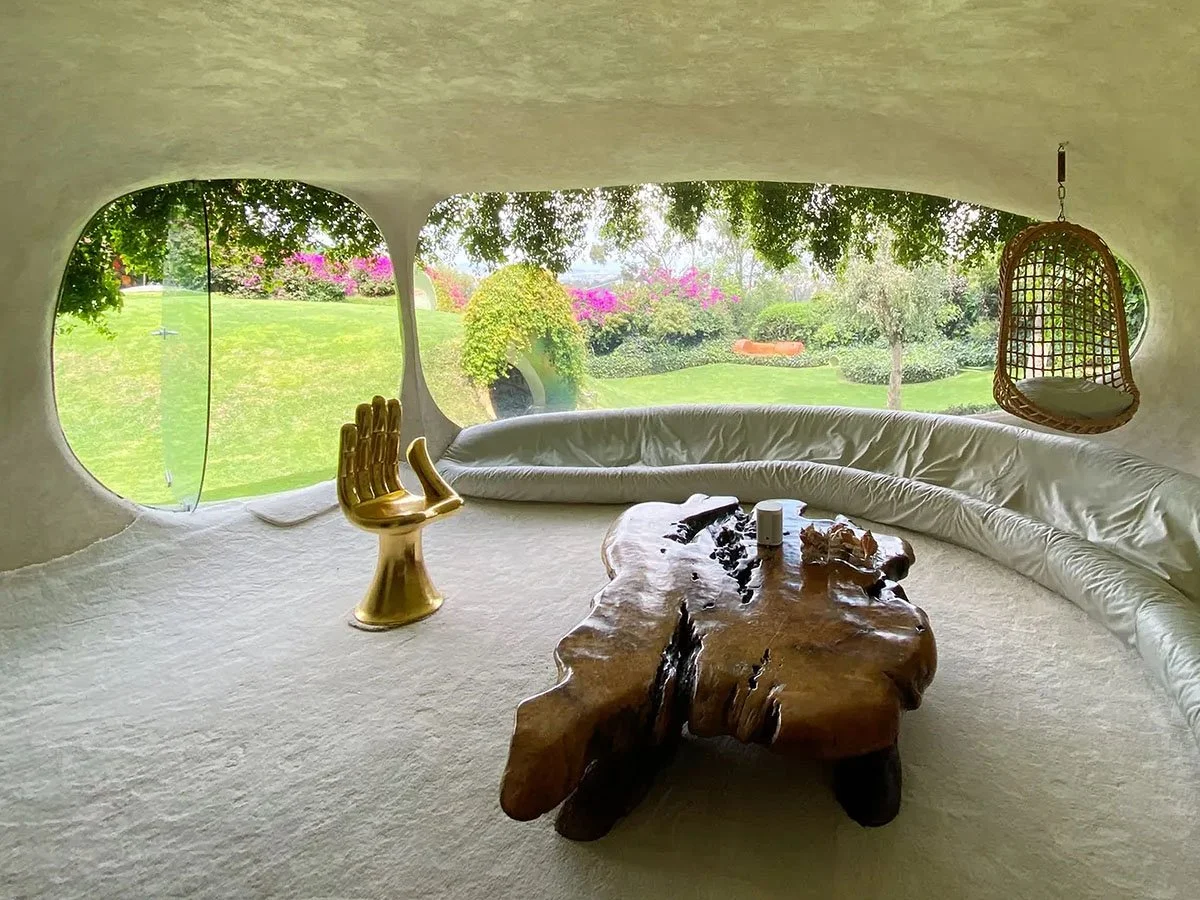
          Casa Organica     , Mexico City
    Casa Organica , Mexico City

    “Some people don’t know enough about set or setting,” says Dr Kyle Buller, while lecturing his Vital students on the reality of providing a psychedelic integration therapy service.

    Edgelords like us might consider it borderline basic to bust out the tarot cards.

    But this is the general public we’re taking out to the edges of consciousness here. It’s probably a good idea to ease them into the whole tripping thing kind-of gradually. 

    Kyle’s trade secret solution? A mock min-ceremony.

    “You can run, say, a thirty minute breathwork session to find out what clients are comfortable with,” he advises the seasoned transpersonal therapist, cannily.

    Sensing out what trippy vibes a virgin voyager’s into – and which they’re decidedly against – could make the difference between them bathing in transcendent bliss – or suffering a total bummer.

    How much woo-woo does the client fancy during their experience on a scale of one to ten? Perhaps world music reminds them of their dad? Does incense give them a headache? “Some people simply don’t like those strong smells,” says Kyle.

    And may their taste be better suited to a jungle retreat than a western clinic? All this even before we get on to the hugging or not thing.

    “A set-up of a ceremony is also a good opportunity to show them how to breathe through difficulty, how to intensify the experience, how to titrate it”

    Nervy initiates might just answer ‘I don’t mind’ when asked what their preferences might be, whether they’re deciding which exotic plant medicine to choose from, or how to set out their lounge before a Bloombox-style at-home medical experience. 

    But their subconscious might be more assertive, once unleashed. And decide it’s really triggered by classical religious music like an Arvo Part composition say, when you didn’t even twig it was a christian jam.

    Or they may seriously not like being touched when they’re coming up, and dislike even a supportive pat on the shoulder.

    “A set-up of a ceremony is also a good opportunity them show to breathe through difficulty, how to intensify the experience, how to titrate it,” says the seasoned transpersonal therapist and Vital course leader. 

    Easy on the sacred tobacco.

  • The Feeling Theory

    The Feeling Theory

      Approach
    Approach

    Dr Lafrance mixes up emotion focussed therapy with a ‘theoretically informed’ treatment room style – that involves interacting with the patient

         By      Nokukhanya Langa      showing at Saatchi Yates gallery, London till November 22
    By Nokukhanya Langa showing at Saatchi Yates gallery, London till November 22

    “There’s been an evolution in psychedelic therapy, says Dr Lafrance, “I’m presenting all this next year, so you’re getting a sneak preview.” 

    Contemporary psychedelic medicine began with ‘experience’ sessions were ‘non-directed’, that is, given as little intervention as possible. (Psycholitic is the name given to experiences where talk therapy takes place). Soon they became ‘inner directed’ encouraging the voyager to get in touch with their ol’ inner healer.

    But now, “We’re moving towards a theoretically informed way of being in the treatment room,” Dr Lafrance reports, “especially when the inner healing intelligence is most active.”

    If like me you’re wondering what ‘theoretically informed’ means, well, from my Googling I figure it’s an academic term for ‘rooted in reality’ and usually involves some form of research and sense-checking from folks actually doing the thing in question.

    For instance: one paper I found, which researched ways to encourage intravenous drug users to be tested for hepatitis C, insisted it employed ‘evidence based and theoretically informed techniques’ gleaned from social workers.

    Dr Lafrance later describes herself as “a theory-based person” and I for one will happily accept her theories when it comes to ‘ways of being in the treatment room’, because she’s been a top-flight clinical psychologist for decades. 

    “They indulge in maladaptive coping behaviours and problematic relationships to cope… or risk more serious mind fractures” 

    The bubbly brainbox is also a renowned expert on Emotion Focussed Therapy (EFT); she’s the author of Emotion Focused Family Therapy: A Transdiagnostic Caregiver Focused Guide, published by the redoubtable American Psychological Association. 

    According to The International Centre for Excellence in Emotionally Focused Therapy (ICEEFT) website, EFT is closely related to John Bowlby’s Attachment Theory of Human Relationships. ‘Attachment views human beings as innately relational, social and wired for intimate bonding with others,’ it reads, ‘The EFT model prioritises emotion and emotional regulation as the key organising agents in individual experience and key relationship interactions.’

    Dr Lafrance says EFT focusses on emotion regulation and processing: “If they have low skills regulating emotions and stressors, and their resources are insufficient, they have to indulge in maladaptive coping behaviours and problematic relationships in order to cope – or they risk more serious mind fractures.” 

    In the EFT model, seemingly destructive patterns like addiction fend off worse outcomes like suicide.

    “You get this activated self rising like a phoenix. And it’s freaking awesome”

    Addicition’s an example of a coping mechanism that’s arisen to swamp the torturous emotional quagmire within.

    “Cross-diagnostically patients have problems with identifying and processing emotions,” says Dr Lafrance, “the symptoms are thought to be emotion regulation strategies. But if we can offer them support, including in strengthening their emotion regulation and processing skills, they receive co-regulation that in turn leads to self-regulation. Then they don’t need the coping patterns. It’s tackling the problem from the inside out.”

    “The key term,” says Dr Lafrance, “is self-efficacy,” meaning the power to deal with things yourself. “If you feel it with emotion processing,” she claims, “it’s incredible armour for the challenges of life: both the skills, and the support it provides.”

    Our emotional landscapes, though, can be foggy territory. Dr Lafrance has even felt the compulsion to hold free public workshops helping the great unwashed map out their own internal geography. Many of us are simply not literate enough to know that behind the emotion of ‘sadness’ there’s a need for ‘comfort’ from another – the common reaction is to withdraw for time alone instead. 

    “Which emotional states do they find most challenging to identify, label, meet and need?” advises Dr Lafrance, “Stick with the sense of helplessness and that turns into ‘it’s not fair!’ And then there’s a healthy rising up of assertiveness. Latch on to something, work with it in specifics ways that help it along, and you get this activated self rising like a phoenix. And it’s freaking awesome,” she says.

    As a people we’re so emotionally retarded that Dr Lafrance has found it’s sometimes best to simplify troubled emotions down into two categories.

    “In the past when I would’ve said ‘Feel into that space with me’ now I’d just say, let’s not go there if you’re not sure”

    ‘Anger, resentment and disappointment’ indicate a client who shies away from vulnerability. ‘Anxiety, sadness and despair’ point to low assertiveness.

    But “hate and resentment can feel like a comfy blankety” advises Dr Lafrance: “Some people subconsciously live their lives by the mantra ‘I’d rather die than feel’,” she says.

    This is where “accessing and understanding the genus of their difficulties” comes in. “One patient told me that their medicine sessions were the first time they’d sat in fear and sadness with memories they were trying to hide from,” she explains, adding that psychedelics can quieten a harsh inner critic that usually directs repressed feelings towards their holder, away from the recognition of painful events. 

    But, “EFT is less about the memories than it is about processing,” says Dr Lafrance, “they’re regulating, avoiding or suppressing affective material. Understanding the pattern can diffuse shame and assist in moving through the emotion.”

    To quote humanist psychologist Carl Rogers: ‘Once an experience is fully in awareness, fully accepted, then it can be coped with effectively, like any other clear reality.’

  • Appliance of Science

    Appliance of Science

      Approach
    Approach

    Purists sneer at scientific tinkering. But lab studies showed Dr Nichols how psychedelics heal the body. Could he uncover the secret of profundity too?

         By      Ryoichi Kurokawa
    By Ryoichi Kurokawa

    Neuroscience is different to other aspects of psychedelic study, ‘since it is so spectacularly and usefully right over so many things.’

    Raymond Tallis wrote those semi-satirical words in Aping Mankind: Neuromania, Darwinitis and the Misrepresentation of Humanity. Neuroscience ‘is often given authority where it has none’ warns Tallis.

    Grudgingly I admit all those long words and graphs might come across well in a formal context. During a presentation to drug legislators, for example. Certainly compared to showing a clip of Tales from the Trip on the the meeting room’s wall-mounted LCD screen. 

    So it’s sweetly satisfying for heads to beat bureaucrats at their own game with the slew of pro-psychedelic neuroscience stats flooding out of respected institutions.

    Granted, the arcane apparatus of the psychedelic experience itself remains beyond even the grasp of they who have mastered the most multisyllabic words from this incomprehensible, in-style, inculcation. 

    “That’s still a wide open mystery,” confesses Dr Charles Nichols, eminent psychedelic pharmacologist and Vital neuroscience lecturer.

    “Specific pathways may be involved in the psychedelic process”

    Charles is the son of Dr David Nichols, chemist to the stars. David made the DMT for Rick Strassman, MDMA for MAPS and psilocybin for Johns Hopkins.

    “Back in the 2000s my father’s lab looked at the cross talk downstream from when G-alpha-i protein interacts with a specific beta and gamma that activates a hormone called Src, which then activates a series of enzymes. That’s the very top effector.”

    Right. No wonder nobody’s got to the bottom of it as yet. 

    “Specific pathways may be involved,” Charles whispers conspiratorially to the cheap seats.

    No talk of neuroscience in these pages is complete without a mention of Greatest Living Englishman Dr Robin Carhart-Harris.

    Dr Carhart-Harris’ sympathetic yet rigorous research at scientific bastion Imperial College London brought the psychedelic experience its medical legitimacy. His REBUS, ‘relaxed beliefs under psychedelics’ model is widely considered the neatest summation of psychedelic neuroscience. (without wishing to damn it with faint praise). 

    “My lab studies what psychedelics do that serotonin doesn’t”

    For anyone too embarrassed to ask the scientific way to say ‘tripping’ is ‘Relax the precision of high-level priors or beliefs, thereby liberating bottom-up information flow, particularly via intrinsic sources such as the limbic system.’ Obviously.

    Dr Charles Nichols is a pharmacologist developing new drugs. Unlike his celebrated psychedelic chemist dad Dr David, Charles has the benefit of Carhart-Harris’ research, or its slipstream at least.

    Charles uses his prodigious skill with the pestle, mortar and petri dish to identify, isolate and augment certain properties within his arsenal of exotic designer psychedelics.

    Specifically, “The study is my lab now is around what psychedelics do that serotonin itself doesn’t,” says Charles. 

    Which is a lot.

    He’s already found that mescaline-derived DOI has a tremendously positive effect on inflammatory conditions including asthma. And, he’s worked out that it’s not even one of the bits that makes you trip. Which has implications aplenty for widespread use. And the sensitive conversation around non-psychedelic psychedelics.

    (Ethnobotanist Richard Evans Schultes wrote in 1938, “Some of the ills listed as responding to peyote were tuberculosis, pneumonia, scarlet fever, intestinal ills, diabetes, rheumatic pains, colds, grippe, fevers and venereal diseases.” Cheers Mark Gunther of Lucid News).

    Psychedelics possess less ‘inhibitory’ effects on brain receptors that might suppress ‘excitatory’ ones, compared to serotonin. They hit the accelerator while cutting the brakes: boosting neurotransmission while hindering the body’s autonomous attempts to bring body chemistry back to ‘normal’.

    “The profound and mystical effect itself is still a mystery”

    This initiates a ‘synaptic cascade’ of excitatory messages. Once that gets to the Raphe nuclei in the brain stem connected to the whole brain, it’s blast off.

    The resulting “downstream cross talk” takes an unusual route through the nervous system. Precisely what is a little vague. Zen meditation buff Dr Bryan Roth is on it with a system he calls ‘TRUPATH, an open-source biosensor platform for interrogating the GPCR transducerome’. He’s also the guy making the non-psychedelic psychedelics for DARPA.

    “All psychedelics have a surprisingly different set of reactions with the 5-hydroxytryptamine receptors associated with serotonin,” says Charles, “but they all work on 5-hydroxytryptamine receptor 2a.” 

    Neuroscientists gave it with the catchy nickname ‘5-HT2a’. Relax, they’ve got loads more.

    Mescaline for example only activates two other receptors besides 5-HT2a. LSD’s “complex pharmacology” on the other hand means it interacts with 17 different receptors in total.

    ‘The phrase 5-HT2a agonist has supplanted psychedelic, which still carries faint whiffs of hippie-era hedonism,’ tech bible Wired tipped us off in its recent feature The High-Stakes Race to Engineer New Psychedelic Drugs.

  • Vegetable rights and peace

    Vegetable rights and peace

      Approach
    Approach

    “If psychedelic therapy embraces animism it can do wonderful things” says star anthropologist Dr Luis Eduardo Luna

      Pablo Amargino, ‘Vision of the Snakes’ via Dr Luna’s    True Amaringos gallery
    Pablo Amargino, ‘Vision of the Snakes’ via Dr Luna’s True Amaringos gallery

    Mention an interest in animism and most folk’ll think you’re holding a seance.

    It’s become a fancy term for the kind of ‘spiritualism’ where a Madame Xanadu type supposedly relays messages from beyond the grave… with wildly varying degrees of authenticity.

    Trivia buffs might extend their apocryphal knowledge to animism being an early religion where pretty much everything – the sea, your spear, that sabre tooth tiger over there – had a spirit essence dwelling within it. They probably got it from anthropologist Sir Edward Tylor who wrote in 1866, ‘the theory which endows the phenomenon of nature with personal life might perhaps conveniently be called animism’ in an article with a title that’d come back to haunt him… Religion of the Savages.

    “Animism is not a religion, or a philosophy”

    Tylor did actually challenge convention at the time by pointing out that the tribes were no less intelligent per se: but their civilisation, such as it was, hopelessly backward.

    You may be unsurprised to learn that most the above displays a grasp of animism that is loose at best.

    “I’m not idolising Amerinidian cultures; there was human sacrifice,” said Dr Luna in the question and answer session after his keynote at this year’s Philosophy of Psychedelics conference, “huge festivities alongside people waiting to be burned.”

    But swotting up on animism seems sensible, considering it’s the guiding ethos of the people who’ve been using psychedelic medicine for at least 4000 years longer than we have.

    If western psychonauts can get to grips with animism, despite our “impoverished worldview” as Dr Luna puts it, the advantages to psychedelic therapy will be significant, he claims.

    And we may be able to arrest the climate crisis. Plus even halt the dreaded Anthropocene

    “Animism is not a religion, or a philosophy” says Dr Luis Eduardo Luna, who was born in the Amazon and first drank shamanic yagé with Terrence McKenna in 1971.

    Dr Luna’s lecture climaxing Vital’s therapy-focussed training module was packed with guidance for modern-day western practitioners the anthropologist brewed up from the historic psychedelic rituals of South America and beyond.

    “Once you re-connect with the world, you know are never alone”

    The religion of many Amazonian tribes is… actually a syncretic christianity, and they combine animistic principles with catholic worship in their ceremonies. The translated lyric sheets of Maria Sabina’s LP contain artfully improvised prayer mixed up with references to her local ecosystem. Syncretic combinations of animism and christianity have been recorded since 1930 and are thriving today.

    Animism is instead a practical path for successful interaction with your environment, “Entirely based on experience,” that urges a “non-conceptual relationship with the natural world. Once you re-connect with the world, you know are never alone,” whispers the man who brought Pablo Amaringo and ayahuasca art to the West.

    Before you think this is all sounding a bit vague and maybe there’s a Zoom lecture coming up about it that you can check out, “it’s not based on a book, or a doctrine,” cautions the anthropology expert.

    Vital lecturer Ashleigh Murphy-Beiner, who worked as a guide on Imperial College’s landmark PsiloDep 2 trials, has studied the effect of traditional ayahuasca use on mindfulness and cognitive flexibility. While presenting the results to the MIND Foundation in 2019 Ashleigh used meditation as an example of a skill that is better learned by practice – direct experience – than via spoken explanation.

    Animistic tribes prize directly acquired knowledge so highly that they don’t have schools. Formal education nonetheless has existed for millennia. The tribespeople never stop learning, and they do have teachers. These are plants (and fungi). Guess which ones? A 4000 year-old fossilised San Pedro cactus, for example, was found in a dig near Lima, Peru. Ayahuasca the concoction is only around 250-300 years old, but its cousin Caapi much older.

    You know exactly what those plants and fungi have to say about ‘reconnecting to the world’ don’t you? Plus how good they are at giving you advice (most of the time, after careful reflection)? 

    Remember too that veteran psychedelic therapists stress the pretty much total importance of first hand experience, not only of the medicine itself but the guide process in particular. More on that over in this week’s Space Holding section.

    Connecting to nature, community and self is apparently key to psychedelic therapy’s success. Luna says a ‘non-conceptual relationship to nature’ is intrinsic to animism too. The ‘lived experience’ of our relationship with the natural world is starkly apparent in the environmental crisis, no matter how many ‘theoretical’ arguments that it doesn’t exist there are. Me weeping over the David Attenborough film with the turtle wrapped in plastic bags while carrying on smearing the same carbon footprint is a ‘conceptual’ relationship with nature, not a real one.

    Recently, some of us in the West who fancy ourselves as adventurous have been re-learning the importance of a (non-conceptual) relationship with nature with the help of the same plant and fungi teachers that have been used in the Amazon for 4000-plus years. In the past we’ve found a load of other useful stuff we found lying around the place. Like cotton, rubber or the majority of medicines we use and food that we eat. Which the inhabitants told us about after we beat the shit out of them.

    “If you feel lonely go outside. Look at the grass growing between the paving stones in your street”

    Hence the weary attitude heading from that direction. “Europe was simply a peninsula of Asia in 1492 when Columbus landed. Power in the region was centred on the Middle East,” mulls Dr Luna mischievously in his presentation to Vital students. He even rolls his eyes at western understanding that man is ‘disconnected’ from nature. In fact, according to Luna the situation’s far worse. “We are narcissists,” he says, “my gut is teeming with bacteria – of course I am connected. But we look only within ourselves. If we were to have silence: no radio, advertisements, vehicles… the answers will come.” 

    Luna’s animistic life hack for the western condition? “If you feel lonely, go outside, look at the grass growing between the paving stones in your street.” Doesn’t appeal much to your dopamine receptors? Unsurprisingly so perhaps, because as Luna explains “the most essential lesson is re-enchantment with the world,” an appreciation of the moment, also a favourite subject of our plans and fungi teachers. Less enamoured are, as Dr Luna puts it, “The people with the habit, the black one or the white one, it is difficult for them.” Sounds like it might be tough for anyone to get their heads around let alone psychic gatekeepers like the the clergy and clinicians. 

    “Selfhood does not apply exclusively to humans. How arrogant an assumption”

    Help explain please Andy Letcher, high-level druid and author of Shroom a definitive history and analysis of psilocybin-based fungi. “It’s about building a relationship with place,” Letcher told Graham Hancock’s son Luke on a podcast for funky Japanese set-up the Kakuichi Institute, “really listening to the world around you in the wider sense. Get close to any plant, meditate next to a tree, and you will feel it.”

    Animism urges respect for the natural world, to the extent that man is a humble part of it alongside not only “the river and the jaguar,” but also “the bee people and the ant people,” as Dr Luna calls our six-legged friends during a keynote presentation about his Wasiwaska psychedelic nature reserve at Exeter University’s 2022 Philosophy of Psychedelics conference.

    Indeed the beaches of nearby Cornwall, Dr Luna points out, are ‘animistic’ and would be ascribed a ‘spirit’ too, one that represents the combined effect of sea, wind, tide, pebbles, crabs, grasses… and humans.

    Importantly, “Selfhood does not apply exclusively to humans, how arrogant an assumption,” advises Dr Luna. Instead according to animism we’re part of an ‘ecology of selves’ symbiotic to the environment.

    It works both ways. “Any sentience is worthy of respect,” says Dr Luna and mankind has certainly done well out of stuff he’s found lying around over the centuries. In the Amazon especially, as it happens. The better we do by it the better it’ll do by us. In general, that is. One of the lessons of life’s direct experience is that some thing are simply bigger than us, and this can develop self-compassion to soothe more challenging emotions like loss.

    “Animism is entirely based on experience”

    Being a dickhead to another human on the beach in Cornwall would probably cause a ruckus, right? Applying animism to the beach scenario, being a dickhead to anything – anyone – up to and including the pebble people (maybe beyond) causes a degree of disharmony. And from disharmony, not singing in time, comes disenchantment, a lack of meaning, purpose, and belonging.

    Through lived experience we learn, sometimes bitterly, that we’re not the only things that might cause disharmony, or spread it. It teaches us ways to hone our own vibration, to just the right pitch.

    Usually. Because we are not as important as we think we are… another pet subject of the plant and fungi faculty. 

    We don’t like to accept that we aren’t, though. And we’ve dreamed up ways to avoid any lived experiences that might remind us we’re not. I initially made a long ranty list of these to publish here, but let us all instead ponder our own myths of avoidance and denial. For inspiration, Luna quotes Davi Kopenawa, a shaman from the Yanomami region where gold mining has caused mercury levels in unborn babies to rise by nine times. “His is a sort-of ‘reverse anthropology’,” says Luna:

    ‘White people call us ignorant because we are other people than they are. But their thought is short and obscure. It does not succeed in spreading and rising because they prefer to ignore death. They constantly drink cachaca and beer, that overheats their chests and fills them with fumes. This is why their words become so bad and muddled. We do not want to hear them anymore.

    They do not dream as far as we do. They sleep a lot, but only dream of themselves. Their thoughts remain blocked in their slumber, like tapirs or tortoises. This is why they are unable to understand our words.’


  • Indistinguishable from magic

    Indistinguishable from magic

      Approach
    Approach

    Dr Ben Sessa’s greatest conversation stopper: psychedelics are a ‘psychic antibiotic’ capable of statistically curing mental diseases

       Novotak   , ‘Daydream Version Six’
    Novotak , ‘Daydream Version Six’

    “Psychiatry is a pretty desperate and miserable place to work.”

    Dr Ben Sessa’s been at the frontline of mental health services since 1997, and deserves a rant. “Where are we going wrong? We’ve had modern psychiatry around for 100 years. And we’re not getting the kind of clinical outcomes we want,” he opines, “younger people get given the SSRIs, can’t work the therapy, and kill themselves.”

    ‘Psychic antibiotic’ is another of Sessa’s bravura catchphrases. Mental health treatment’s in a miserable state of affairs comparable to general medicine in the late 1800s, says Sessa who first presented his vision that psychedelic medicine could be revived to the Royal College of Psychiatrists in 2006.

    “Doctors were losing the battle to the infectious diseases, leprosy, smallpox, tuberculosis, people dying post-operatively,” he continues, flexing his storytelling skills in a swaggering lecture, “Back then, were very good at our statistical analysis and epidemiology too. We knew that people were dying, but it wasn’t clear what was going on.”

    Things changed when a joint German-Japanese team discovered a cure for… syphilis in 1908, and Nobel prizes ensued.

    “Where is our treatment that gets to the heart of disorders?”

    ‘Antibiotics’ as they were called, ‘cos they killed bacteria, include any micro-biological treatment for bacterial infection, not just other bacteria bred to fight against their microscopic kin.

    Penicillin, invented by Sir Alexander Fleming in 1928, is derived from a fungus secretion… just saying. Specifically a mould, which are traditionally used for their anti-infection properties.

    “Where is our antibiotic?” bellows Sessa in the general direction of the gods, “Where is our treatment that gets to the heart of disorders, and actually cures them? We write these voluminous tomes,” he continues, hitting his stride, “The ‘DSM’ and ‘ICD’. We track who gets depression, and anxiety, and eating disorders, and personality disorders, and addictions, and affective disorders,” here it comes, “…but we’re not very good at treating them.”

    Dr Sessa’s allowed to ham it up like this because he is legit as any clinician, researcher or spokesperson.

    “The idea that healing patients would be a bad business model is sick”

    It’s almost like the anthropology reports from the Amazon… where researchers are struck by the animist doctrine that you’re only allowed to talk shit about stuff you’ve actually done…

    Tell us why our ailments continue to vex us so, oh unlikely shaman returned from the darkest depths of the forest with knowledge?

    “Because we treat them symptomatically,” answers Dr Sessa, “We provide a whole plethora of daily maintenance drugs that mask the symptoms. Which the pharmaceutical industry queued up to provide us with.”

    Yet there is hope. Way back in 2012’s breakthrough Psychedelic Renaissance, Sessa’s book which coined the phrase, he was already declaring psychedelic medicine the ‘psychic antibiotic’ that his profession and his patients crave.

    In his Vital presentation during the course’s second module covering psychedelic therapy styles, Sessa beams with pride after battering his return key to reveal a graph showing MDMA-AT thrashing a combination of the best anti-addiction treatments money can buy, plus 12-step and more, by a 73% to 21% recovery rate.

    “We’re not going to cure everyone and therefore put ourselves out of business”

    Sessa’s surging Awakn chain though, is a listed company. Like other private medical providers, doesn’t he have a duty to shareholders to drag treatment plans out too?

    “The idea that healing patients would be a bad business model is sick,” and he doesn’t mean in the same way he dryly describes my wannabe-hipster home town of Bristol as ‘extremely sick’ in his introduction, “sustaining poor treatments with poor outcomes in order to maintain a customer base is absurd.”

    Accident wards don’t keep your leg held up in traction forever. “There’s plenty of work out there for orthopaedic surgeons mending broken legs,” explains Sessa to an enquiring Vital student in the Q&A, “plus there are plenty of people out there who could do with their mental disorders being completely cured. We’re not going to cure everyone and therefore put ourselves out of business.” 

  • On the couch 2.0

    On the couch 2.0

      Approach
    Approach

    Psychedelic snobs like me sniff at ketamine treatment. But patients with lived experience say it works

      ‘Infused Vocabulary’ by    False Negative Art
    ‘Infused Vocabulary’ by False Negative Art

    There are now hundreds of clinics in the USA dispensing psychedelic-style treatment using what we used to call ‘regretamine’ (as in “I regret having that ketamine”) and ‘ROFLcopter’.

    Depression, PTSD and addiction, including for cocaine use disorder, are the conditions treated. Novamind’s six clinics in Utah expect a more than 200% rise in patient numbers next year, up to 65,000. Waiting lists are already two weeks long for a single infusion. While Spravato’s inhalers have become synonymous, lozengers are used too and an adjustable IV drip is considered the most workable method overall.

    In her lecture covering the K-clinic phenomenon, specialist ketamine therapist Veronika Gold told Vital students that a raft of approaches are required to suit patient needs. Treatment modes range from the purely medicinal, including Mindbloom’s at-home service, to a psycholytic take where therapy takes place during the trip, to the psychedelic approach nailed down by Stan Grof where discussion occurs between guided, internal drug experiences (this is Awakn’s method used in the UK).

    However, US insurance codes cover the substance but do not currently include accompanying psychotherapy. Patients’ strong reactions to emerging trauma on early trips have encouraged many dispensers to provide a sitter for inaugural unaccompanied voyages nonetheless.

    I’m a complete snob about ketamine masquerading as a ‘psychedelic’. I can’t help but feel gaslighted by the assumption. LSD has given birth to its own rich culture of art and ideology. Even MDMA (also not a psychedelic) gave birth to rave. Where, I ask, are ketamine’s contributions to the collective imagination?

    “I was able to go into the outside world without a sense of impending doom”

    Moreover. I for one, given my own history with this particular ‘medicine’, have been less than compassionately curious as to ketamine’s therapeutic worth, in comparison to what we now have to call ‘classical psychedelics’ and indeed MDMA. Reports are varied but most are positive compared to existing treatments. Many are euphoric; others a disappointment. I’m heading off for the sharp end of guide training in a month and it feels incongruous not be getting first-hand know-how of ketamine therapy too.

      Close-up of the IV bag used in ‘Infused Vocabulary’ by    False Negative Art
    Close-up of the IV bag used in ‘Infused Vocabulary’ by False Negative Art

    Thankfully, trustworthy circle buddies have, both microdosing and the full clinical shebang. Know what? Their verdict is… thumbs-up. 

    Kelli Ann Dumas is a psychotherapist in my Vital study group. She received ketamine treatment after two decades working as a first responder in disaster zones, and with the US military abroad. While first responders do not require a PTSD diagnosis to obtain treatment in the USA, Kelli’s career has included the ‘direct threat to life’ instances this usually requires.

    “In the completing treatments rose joy. A positive, giving dynamic. Love and fire”

    She says of her symptoms, “My intrusive thoughts were of… being killed. I would live in fear of it. All the time.” 

    After the first dose, “I was able to go into the outside world without a sense of impending doom. The intrusive thinking went away. Anger was still there though. And so were panic attacks.”

    The mental room she free’d up made for a beach head to assault these deeper issues, and Kelli got to work. “Before with PTSD I felt uncommon; only tight and damaged space inside,” she reports, “As my journey went on I was able to claim more of that space internally. When I did feel anger or fear come up, I could back into myself and feel safe.”

    Powerful senses of grief and loss followed as Kelli went deeper, taking lozengers alone amongst Louisiana countryside in her beloved RV with a therapist available remotely. 

    “Love would arise instead and I saw myself journeying like I had in my earlier life – my energy crossing the land. In the completing treatments rose joy: a positive, giving dynamic… love and fire. This became solid inside of myself, instead of the fear.”

    Costly top-ups (weekly blasts add up) haven’t been necessary so far says Kelli: “When the tremble of the trauma comes I remember the call home, and am able to ride over it with my true self of dynamic proportions,” she says. “I don’t inward as much: integration with family is getting better, my exterior boundaries are getting better when faced with negativity.”

  • T-bombs away!

    T-bombs away!

      Approach
    Approach

    MAPS’ latest recruit is trauma pioneer Bessel Van der Kolk author of The Body Keeps the Score

       ‘Gifts for the Psychedelics’ by Wardell Milan, works from      David Nolan Gallery NY
    ‘Gifts for the Psychedelics’ by Wardell Milan, works from David Nolan Gallery NY

    Psychedelic Renaissance author Dr Ben Sessa says ‘trauma is at the root of most unnecessary human conflict and misery.’

    This summer, August 2022 topical spiritual teacher Thomas Hubl launched The Collective Trauma Summit; he talks about activating a “collective immune system.”

    Trauma, on the scale from ‘victim of war atrocity’ down to ‘feel nervous when you see a policeman’, is up there with depression as global burden. According to the US Department of Veteran affairs it touches 350 million people worldwide. That’s in comparison to depression’s head count of 249 million. Trauma is thought be behind many conditions for which there are no currently prescribed medications or therapies: including post-traumatic stress disorder and its domestic derivative complex ‘C’ PTSD, plus substance use and personality disorders.

    “The results in terms of experiences, and the secondary analyses, are spectacular”

    Dr Bessel Van der Kolk, trauma trailblazer and author of The Body Keeps the Score, is overseeing stage three trials for MAPS MDMA-Assisted Therapy for PTSD in Boston.

    Back in the mid-2000s he told MAPS founder Rick Doblin, and program director Dr Michael Mithhoefer, not to try psychedelics for PTSD.

    Since then, Dr Van der Kolk’s become an avid convert: “The results in terms of experiences, and the secondary analyses, are spectacular… transformations that I have not seen with any other treatment modality,” he reports.

    The Federal Drug Administration has designated MAPS’ own MDMA-Assisted Therapy for PTSD program officially a ‘breakthrough therapy’, that offers ‘substantial improvement over available therapy for a life-threatening condition.’

    “We have lost our minds. Here we have a chance to reclaim them”

    It wants to treat a million people every year and train 300,000 therapists by 2031. In keeping with its charitable vibe, MAPS is focussed on widespread availability, including for example BIPOC and low income sectors. The model will be available free of charge, and MDMA is out of patent. 

    “To my mind, psychiatry lost its soul in its marriage to the drug industry as psychiatrists largely became a bunch of drug pushers,” says Dr Van der Kolk, “we have lost our minds; here, we have a chance to reclaim them. But boy, am I worried about profits. That sort of stuff can really get in the way of creating optimal healing environments. I’m really worried that people will do this by themselves or with friends or in unprotected situations, because you really open up Pandora’s box with MDMA-AT.”

    Dr Van der Kolk says he “…mainly joined at that point to keep things very serious and very strict. Because I had seen how it blew up the last time,” alluding to scandals from 2015 dug up by New York Magazine’s The Cut podcast and intrepid news hounds at campaigning news source Psymposim.

    “The results are spectacular… transformations that I have not seen with any other treatment”

    Undergoing MDMA treatment himself convinced Van der Kolk of its potency. “I was just lying there going, ‘Oh shit, are you sure this is a party drug? Because I felt all the pain that had been dumped on me throughout the years. People asked me all the time: How do you deal with all this stuff? And I always said, ‘Oh, as long as you have a good support system and as long as you have a good marriage and you have good friends, you get to talk about your stuff, It doesn’t really become part of you.’ Well, I was wrong. On MDMA, I got to see that indeed this stuff had come inside of me, burrowed itself into the very core of my being. And it has affected me, my perception of things.”

    While MDMA shrinks amygdala activity subduing fear, healing takes place by fully experiencing repressed thoughts and feelings, like during LSD and psilocybin therapy. Yet, “It’s quite different from a psychedelic,” says Dr Mithoefer, “The term proposed is ‘entactogen’ meaning it brings one closer to others and oneself,” comments on the decision to use MDMA, “but it’s not a new idea, in the 70s and 80s a number of therapists used it.” In his later Vital lecture, UK thought leader and Awakn chief Dr Ben Sessa says he believes MDMA is the best drug for therapy.

    “Processing trauma in therapy can be very challenging and painful. It’s not a cakewalk”

    When patients take MDMA says Dr Mithoefer, “There’s often more insightfulness and less perceived loss of control. It doesn’t tend to cause hallucinations, and people are more in touch with their surroundings than with psychedelics. However, even with MDMA this is all relative. If you’re processing trauma in therapy, it can be very challenging and painful. So it’s not a cakewalk.”

    What shone out to Dr Van der Kolk was the self-compassion, evolving rapidly into acceptance, that MDMA treatment accessed inside its patients. “They stopped judging and beating up on themselves. They had a sense of internal generosity, a capacity for self-acceptance: and with that, the accepting of other people. They’d no longer defend against parts of themselves they couldn’t stand… and project on others.” What would normally be ‘triggering’ leading to self-defeating reactions is purged from the system… once felt in full.

    “Part of functioning well is knowing what you feels, know, and needs to be done”

    Pioneering child psychologist John Bowlby famously said, ‘What cannot be told to the mother cannot be told to the self.’ Resulting from this inner conflict is ‘alexithymia – ‘experiential avoidance of emotions as an emotion regulation strategy.’ Canonical 20th century psychoanalyst Joyce McDougall called it ‘disaffection’, “an inability to contain and reflect upon an excess of affective experience.”

    The disaffected respond by ‘pulverising all trace of feeling, so that an experience which has caused emotional flooding is not recognised as such and therefore cannot be contemplated,’ according to 1989’s Theatre of the Body. This sounds like most people I know, to be honest. (McDougall also identified ‘normopathy’, the fear of difference).

    Alexithymia was coined in 1973 by psychiatrist John C. Nemiah, a Yale and Harvard Medical school graduate and editor of the American Journal of Psychiatry. Some folks think it’s just a personality trait; ‘guys who can’t express their emotions’. Poor emotional intelligence is certainly a hallmark. Sufferers can certainly feel ‘happy’ and ‘sad’ but have little vocabulary to examine or discuss their state any further. In their relationships they are distant, over-rationalised and lack intimacy. They often lack assertiveness, and make decisions without taking their emotions into account leading to a dissatisfaction they cannot pin down. This develops into dysphoria, ‘a profound sense of unease.’

    One of the most difficult parts of my own ADHD diagnosis was the chapter in Gabor Maté’s Shattered Minds that told me I didn’t have an identity.

    “What you see in the MDMA-assisted therapy is that people have a self. They say, ‘This is who I am’.”

    Instead I was a series of behavioural diktats intended to please others, or get them off my back at least. 

    “The latest neuroscience stuff in the area of trauma is very much about the loss of sense of self that comes from it. And indeed the vast majority of our subjects in the MDMA-assisted therapy study had terrible Alexithymia scores,” said Dr Van der Kolk on Norway’s Psykologvirke podcast, “as long as you live with caregivers who don’t see you, that really impairs your capacity to know who you are and what you’re feeling. This is very much part of becoming a well functioning human being: to know what this creature that you inhabit feels, and knows, and needs to be done.”

    Beautifully, “What you see in the MDMA-assisted therapy is that people have a self,” observes Dr Van der Kolk, “They say, ‘this is who I am. This is what I feel, this is what’s important to me. That’s what’s unimportant to me. And I’m no longer dependent on what you feel to dictate what I feel. I have my own feelings’.”

    More MDMA therapy articles here on New Psychonaut:

  • Feed your head

    Feed your head

      Approach
    Approach

    Patients say psilocybin offers “experiencing everything” in contrast to the ennui of SSRIs

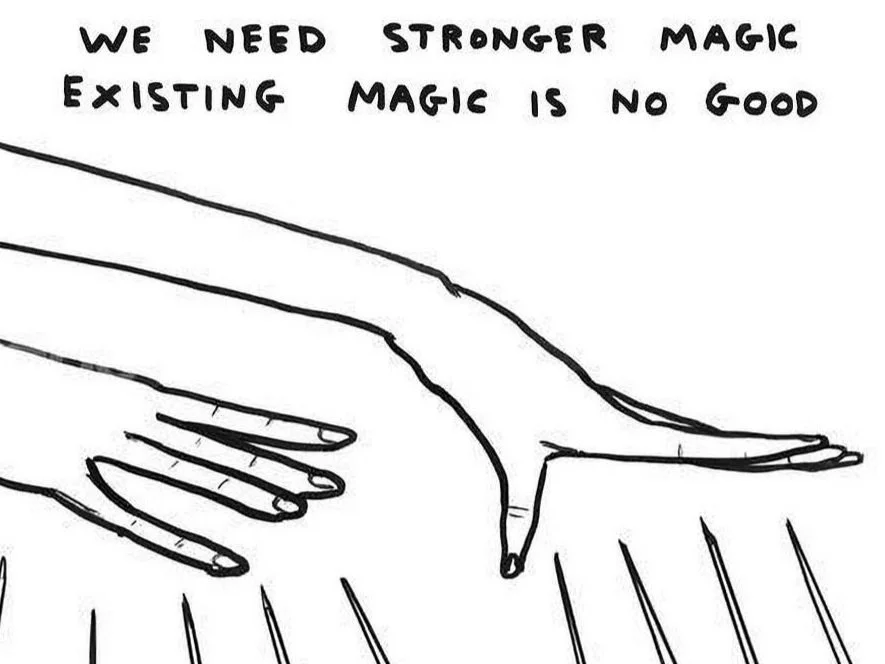
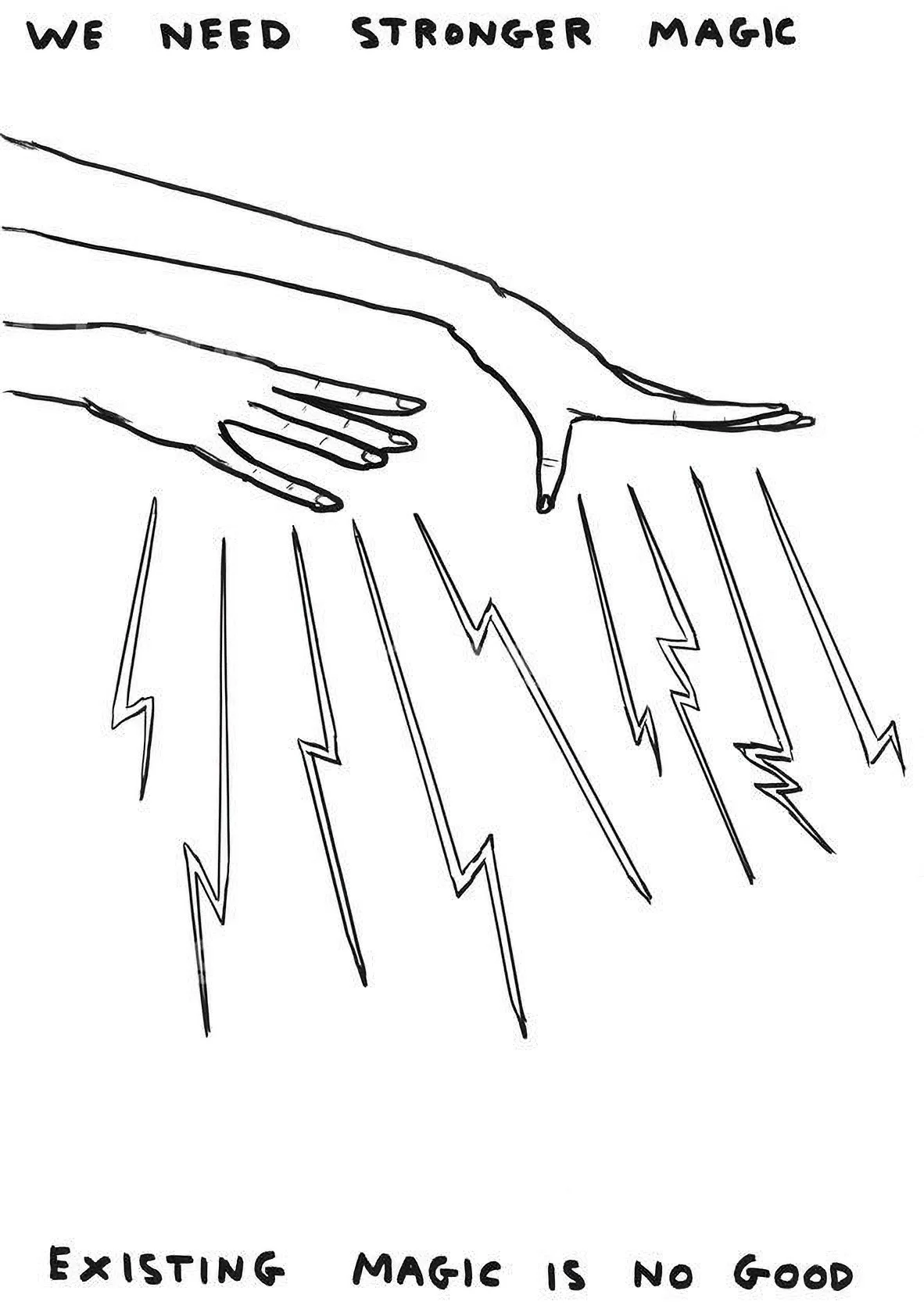
       David Shrigley, ‘Magic’. Works from      Lougher Contemporary
    David Shrigley, ‘Magic’. Works from Lougher Contemporary

    Depression is a problem. One is six Brits are prescribed drugs to counter it. But still nobody knows what it is, how it works, or how to cure it. 

    This is in stark contrast to the popular narrative that ‘depression is caused by an imbalance of ‘“happiness chemical” serotonin in the brain’. The most popularly-prescribed anti-depressants ‘selective serotonin re-uptake inhibitors’ or SSRIs regulated it. Apparently. Like you might conclude by the name ‘selective’ and ‘serotonin’. Or by reading research in respected medical journal The Lancet, written by senior psychologists at Oxford and Yale; although the average depressive is more likely to get the mis-info off commercial content blogs from psychiatrists. 

    SSRIs have some worrying side-effects. Like nasty poos, even worse sleep, plus most notoriously loss of libido – which is no good if your relationship is already on the rocks because of your depression. Or your redundancy, which is a major cause of depression but not taken into account by the medical sector. Plus, the ‘medical model’ actually makes patients feel more stigma around their depression than otherwise.

    SSRI users report an ‘emotional numbness’ known medically as ‘SSRI-induced indifference’ with practical effects not dissimilar to depression itself. ‘Evidence indicates that a reduction in depressive symptoms may not be the single most important outcome to patients, but rather factors such as the ability to participate in everyday activities and return to work,’ says this British Medical Journal article from its 2020 Evidence Based Medicine special issue.

    “It was like the light switch being turned on in a dark house… [my] concrete coat had come off”

    But SSRIs do increase serotonin levels (like recreational ecstasy) although possibly reduce them long term (like recreational ecstasy). Plus – anecdotally – my close friends who are prescribed SSRIs do say “help take the edge off.” I wouldn’t want to go without my ADHD meds, which do make an enormous difference. But neither SSRIs nor my Amfexa go any way towards curing the conditions, only reducing symptoms.

    A balls-out report from UCL published only this summer, made headlines by highlighting the gap between this narrative and reality. And we know what happens when anybody does that. (Like I’m fond of quoting, in the original version of The Emperor’s New Clothes the child who points out the emperor is naked is banished to the wilderness. Not made king instead by a grateful populace, which is a modern alteration). 

    The status quo brought out its big guns. Rolling Stone, once the organ of the counter-culture, spread muck all over author Professor Joanna Moncrieff (of University College London, one of the most respected medical research centres in the world, while Rolling Stone is no longer respected as a pop music magazine, just saying) pointing out her membership of the Critical Psychiatry Network ‘Which aims to “[mount] a scientific challenge to claims about the nature and causes of mental disorder and the effects of psychiatric interventions.” Like RD Laing. Rolling Stone also drew attention to, and those of a sensitive disposition please stop reading now, her reticence for… vaccine mandates, as expressed in an open letter to the British Medical Journal from NHS workers that she signed. The real problem was that some of the shrill left’s enemies on the shrill right, like Fox News rabble-rouser Tucker Carlson, agreed with the paper. 

    I’ll stop before I get depressed. The point is: psychedelic treatment for depression counters the ‘emotional numbness’ of the condition, on or off SSRIs.

    In fact, the opposite happens. “It was like the light switch being turned on in a dark house, the concrete coat had come off,” said one PsiloDep Trial participant according to the vital presentation by Ashleigh Murphy-Beiner, a psychologist on the trials and facilitator of its dedicated ongoing integration circle. Another trial patient said: “I allow myself to experience everything, even if it’s sadness. Now I know how to deal with my feelings rather than rather than repress them.”

    Why? “Oceanic boundlessness” AKA increased connectivity, the mystical trip accompanied by profound meaning, “going beyond the self”, and resolution of emotions (it’s usually shame according to Murphy-Beiner) by mini-spiritual emergency-cum-challenging experience are the top signifiers. This is before we discuss the default mode network, neuroplasticity, or neurogenesis. The ‘inner healer’ or ‘homeostasis principle’ to use its new scientific name dispenses these as required.

    If depression can be cured by restoring powerful human instincts like connection and meaning, is it caused by a lack of them? Former narrative cheerleader yet admittedly rather good writer Johann Hari made his comeback from exile with Lost Connections: Uncovering the Real Causes of Depression – and the Unexpected Solutions (here’s the TED Talk). Therein he claimed, backed up by doctors and patients, that depression is mostly caused by our bureaucratic dystopia: “the depression of many of my friends, even those in fancy jobs – who spend most of their waking hours feeling controlled and unappreciated – started to look not like a problem with their brains, but a problem with their environments,” he writes. And well done him. Although depression is not my area, and I’m far from qualified  as a pro, it’s very tempting to agree.

    But if the problem isn’t brain chemistry but civilisation itself, isn’t sending depressives back out after psychedelic treatment into the same desperate non-life that made them so desperate in the first place just going to make them depressed again? At this point one can only make a fart joke, and nobody can get away with that better than proper brain box Dr Chris Timmerman, who tweeted this new report Understanding the effects of serotonin in the brain through its role in the gastrointestinal tract because it describes psychedelics as ‘cognitive laxatives’.

  • Power to Empower

    Power to Empower

      Approach
    Approach

    Inner journeys require deft guidance deployed with subtlety

       From Seascapes by Paul Rosteau published by      Loose Joints
    From Seascapes by Paul Rosteau published by Loose Joints

    Talismanic underground figure Leo ‘The Secret Chief’ Zef began his psychedelic guide self-training using talk therapy in his voyagers’ sessions.

    Eventually he wrote, “I realised I didn’t know what they needed and neither did they. Something inside them did. Just leave ‘em alone!”

    Photos of the general public tripping in blindfold-and-headphones under strip lighting prompts revulsion in recreational users – or it did in myself, certainly.

    Stanislav Grof, ‘The godfather of LSD’ according to its inventor Albert Hoffman, who ‘nobody has contributed as much to the development of my problem child’ explains in his landmark work LSD Therapy that he went through a similar thought process as a researcher in the 1960s and 70s. 

    The simultaneous model,‘psycholytic therapy’ Grof says does have its advantages compared to regular psychoanalysis, cutting treatment times by a third. But the doses he believes are too regular and possibly too small. Most importantly, the open-ended process has no focus on the rigorous analysis and integration of insights. 

    “It will seem weird to them. Normalise. Don’t pathologise”

    Grof concluded that ‘psychedelic therapy’ which features three to four regular therapy sessions punctuated by high dose experiences where the patient mostly corresponds with their inner healer, 

    While skilful guidance by the therapists can make impact, this requires elegance and subtlety. 

    Vital Week Ten lecturer Kylea Taylor has worked for Grof Transpersonal Training since the 1990s. Like veteran Dr Bill Richards back in Week Four, she says the number one thing to keep in mind is the existence, and the potency, of the inner healer. In an ethical context this means trusting the client’s relationship with the process more than yourself. 

    “Work at the speed of safety. Move at the speed of trust”

    Creating a sense of permission to unfold, “the power to empower” is a very different role to that of the modern psychotherapist, who in my own experience prefers their narrative to any individual ones. Let alone any insight dispensed by cosmic visions.

    “Normalise, don’t pathologise,” says Taylor, “It will seem weird to them, outside their own frame of reference.” While I absolutely agree this will be true for some voyagers, I’m inclined to believe plenty of others will find their fantastical visions more compelling than a grim raking over of their early childhood, accompanied by a gentle shaming of any non-narrative impulses. Get out the Soul Collage, which is like a ‘make your own Red Book kit’.

    “Think, ‘How can I support this client to take their next step into freedom, where they can be fully who they are?’” Says Taylor, again echoing Bill Richards who worked alongside Grof for many years, this time with his ‘cosmic midwife’ allusion. Providing examples, stories and suggested reading are more appropriate than Freudian psychoanalysis, which can seem terribly pompous when you’re tripping. Just like all cokeheads. Stop gabbling like one right now: “Part of good attunement is not knowing what’s going on with them and attuning nonetheless,” says Taylor. 

    And don’t rush it, despite the promises of miracle cures. “Work at the speed of safety… move at the speed of trust. Especially with clients who have a different life experience.”